|
Micah 5. 2-4; Isaiah 35.1-10
Zephaniah 3.14-18; Luke 1.26-38 (scroll to bottom for texts) Advent Service of Lessons and Carols Plymouth Congregational Church, UCC The Reverend Jane Anne Ferguson I listened to these ancient texts this week in tandem with hearing the news of the week: the continued debate of impeachment hearings in Congress, the naming of 16-year-old Greta Thunberg, climate change activist, as Time magazine’s Person of the Year and the bullying response of the President to that news, the memory of the Sandy Hook school shooting on its 7th anniversary yesterday, December 14th, and the knowledge that families are still separated at our southern border and children are kept in cages. This is heartbreaking, fear-producing stuff. After the synagogue shooting this past April in Poway, CA, New York Times columnist, David Brooks, titled his column, “An Era Defined by Fear; the emotional tone underneath the political conflicts.” Brooks writes that fear pervades our society. That is really no news to any of us. But he lays it out so succinctly that we recognize it, especially as it is in stark contrast to the celebration of this season. Brooks tells us that politicians use fear to rise to power setting one group or tribe of people against another. Fear comes from our own personal traumas and experiences in childhood and beyond. Fear is exploited by the media to grab headlines. Fear grips our minds, making us numb and unable to hear good news. Fear makes us angry and acting out of anger produces more fear. Fear paralyze sour ability to take practical action, to get stuff done for the good of ourselves, our families, our communities and our world. Fear paralyzes our ability to share abundance, to be generous. Did you hear the word of God proclaimed by our prophets today, Micah, Isaiah, Zephaniah and the gospel writer, Luke? Each of these powerful writers was addressing a community in their time that was beset by fear. Fear of oppression and persecution, fear of failure, fear of even surviving. We are not the first generation to live in the midst of great fear. Isaiah says to the people through all that revitalizing imagery of the barren wilderness coming alive, “Be strong, do not fear! God will come to save you.” Zephaniah tells the people, “you shall fear disaster no more! Rejoice and exult. Do not fear, do not let your hands grow weak...God is in your midst.” The angel says to Mary, “Do not be afraid for you have found favor with God.” Micah promises One who is coming as a shepherd to lead and protect the people. “They shall live secure; [for] this One is of peace. “ These words are also for us in our era of fear. They are not “pie-in-the-sky by and by” words. They hold Truth that grounds us. Truth we can know through our faith, through trusting in God’s presence even in the midst of extreme adversity when there seems to be no hope on the horizon, through putting our faith into action day after day. At the end of his column, Brooks writes, “Fear comes in the night. But eventually you have to wake up in the morning, get out of bed and get stuff done.” My friends, for us that “stuff” is reading and remembering the promises of we have heard in our texts today. That “stuff” is praying with these promises in our hearts and minds. That “stuff” is our daily acts of kindness to combat the pervasiveness of fear. That “stuff” is working for justice, caring for our families, coming to worship, celebrating this Advent season of Hope, Peace, Joy and Love that prepares us to receive at Christmas and beyond, to receive again and again and again the Holy One who came to show us how to be human by being God with us. Does it seem impossible some days to keep on keeping on in the face of the fear and anger in our age? Yes, it does. But remember, the angel says, “With God nothing will be impossible.” And that, my friends, is a promise of pure joy that sustains us through happiness and sadness. Fear not! God is in the midst of you! God is with us! With God nothing will be impossible....barren wildernesses bloom, miraculous births abound, people are united in love rather than hate. God comes in human form, the baby of a poor, migrant woman grows up to show us all how to live in the transforming ways of God! Be joyful and rejoice! Amen. ©The Rev. Jane Anne Ferguson, 2019. All rights reserved. AuthorAssociate Minister Jane Anne Ferguson is a writer, storyteller, and contributor to Feasting on the Word, a popular biblical commentary. Learn more about Jane Anne here. Texts
0 Comments

Isaiah 11.1-10 & Matthew 3.1-12
The Rev. Hal Chorpenning Plymouth Congregational UCC, Fort Collins, Colorado Advent II Repent! That is the key message we hear from John the Baptizer. That would certainly make him popular at a church potluck or an upscale cocktail party, wouldn’t it? I’ve sometimes thought it would be really awkward to have Jesus at Thanksgiving dinner with all of our celebratory excess, but he doesn’t hold a candle to his cousin, John. Many of the paintings and frescoes I’ve seen of John portray him as something of a wild man, looking disheveled and unkempt. One of the very early frescoes labels him in Latin: Ioannis Precursor, literally the forerunner of Jesus. The funny thing for me is that I find those images appealing, because they are often so human in their portrayal. John looks like he bears the sadness of the human condition on his face. His expression seems to acknowledge that humanity is in need of a radical turn-around, and the best way he knows how to do that is to be provocative and to offer a baptism for the repentance of sins, and it is a cleansing ritual not unknown in Judaism. In last week’s sermon, I claimed that John was just the precursor and that Jesus was the one really doing a new thing, not by baptizing with water, but with fire and the Holy Spirit. The idea is that Jesus’ baptism will be transforming us, refining us, not just cleansing us…that it will instill in us a new sense of God’s presence, what Dom Crossan calls a different kind of heart transplant – not of the pumping organ in your chest, but a radical transplant of the spirit within you…that your old spirit is done and gone and that Christ’s spirit is implanted into you. And it would take something incredibly radical to disrupt the food chain Isaiah describes: Let’s face it, if you ever watched Wild Kingdom or Sir David Attenborough on TV, you know that the natural order means that wolves are meant to eat lambs, and that leopards are meant to eat goats, and that lions are meant to eat calves. It is nature, red it tooth and claw. All of us understand that the natural order is less likely to change than human behavior. Unlike the rest of the animal kingdom, we have the ability to choose our responses and our behaviors. But that is a tall order. So, what about disrupting our assumptions? Don’t most of us assume that self-interest is normal and ethical? Don’t we assume that the “invisible hand of the market” is and should control our economy? Don’t we assume that “the poor will always be with us?” and that even though we tried to end homelessness in Fort Collins by 2020, it was something of a pipe dream? (I was told as much by an older Presbyterian clergyperson back when I was on the Leadership Team of Homeward 2020.) Every year for the past 15 years, I have seen our teens sleep out to raise funds and awareness to prevent homelessness, and I’ve slept out with them three or four years…and I’m still waiting for one of my colleagues to do the same! What if one of the young people who participates gets the idea that maybe things don’t have to be the way they are? What if one of them threw everything they’ve got into dreaming up a new way to work on the root causes of homelessness and came up with a solution? With all due respect to the focus on STEM in our educational system, our ethical and social structures need more emphasis, because science and technology are clearly out-pacing economics, social relations, theology, politics, arts, and literature, and as a people, we’re suffering from it. What if parents like me did less to encourage our kids to play competitive sports and get the highest grades and spent more time inculcating the kind of values our faith espouses? What if we stopped trying so hard to make them “successful” and focused on compassion instead? What kind of world might be created if we allow ourselves to be baptized with fire and with the Holy Spirit? Nobody is going to force you to change, to repent, to engage in deep inner transformation. And the reason is simple: nobody can do that for you. Transformation is an “inside job.” And it’s right in the middle of Plymouth’s mission statement of worshiping God and making the kingdom visible by inviting people into our faith, transforming ourselves deeply, and then sending us out into the world. All of us need to work on becoming better citizens of God’s realm, and that will require some realignment of our priorities and it will require some sacrifice of the things relatively affluent Americans love most: recreation, time, privilege, and money. A few weeks ago, I saw a meme on Facebook that said, “Sometimes being a good Christian means being a bad Roman.” And what we stand to gain is what Americans talk least about — you know…the Mr. Rogers values — loving relationships with others, being spiritually and emotionally grounded, relying on neighbors, having a sense of security that does not depend on a stock portfolio, gated communities, or carrying a firearm. And most of all, it means being connected to the presence of God. Being baptized with water? That’s easy. Not so much with fire and the Holy Spirit. Imagine if you heard this prophecy: “The business magnate will support the homeless man. The Democrat shall embrace the Republican as a sister or brother. The gun manufacturer will build tools with the smithy. The Russian oligarch and the Andean farmer will work as one. The refugee and the white supremacist will be at home with one another. And a little child shall lead them.” What would you add to that list of unlikely, but desirable, events? What enemies do you wish would become lovers? What circumstances would you love to transform? God knows there is so much to be done…and there is a place to start. In 1780, John Adams (who considered studying for the Congregational ministry at Harvard before he opted for law) wrote to his wife Abigail from Paris: “I must study Politicks and War that my sons may have liberty to study Mathematicks and Philosophy, Geography, natural History, Naval Architecture, Navigation, Commerce and Agriculture, in order to give their children a right to study Painting, Poetry, Musick, Architecture, Statuary and Porcelaine.” That is what Adams envisioned as transformation and progress, and he risked his life for it. Though you and I know that we cannot change the world overnight, with God’s help we have a place to start: with prayer. The first step is to open ourselves up the transformative power of God…to pray, to talk about, to work for a world that Jesus would recognize as God’s realm. And doing so, we must avoid falling into the traps of despair or hopelessness or lacking trust in God’s presence in the world. We have to keep the faith…just as the Hebrew people did when they were in captive exile in Babylon. You and I have the amazing privilege of getting to pray for and to work for the kind of nation and the kind of world that God would be proud of, and it starts in here. It is a nation, it is a world, that is full of pain, but those may be the birth pangs of coming into a new way of being. You and I are called to be the agents of transformation in ourselves and in God’s world, so in this Advent season of active waiting, let us keep the faith. There is a voice in the wilderness calling, so keep awake, listen deeply, and pray fervently, because the kingdom of God is at hand. Amen. © 2019 Hal Chorpenning, all rights reserved. Please contact hal@plymouthucc.org for permission to reprint, which will typically be granted for non-profit uses. AuthorThe Rev. Hal Chorpenning has been Plymouth's senior minister since 2002. Before that, he was associate conference minister with the Connecticut Conference of the UCC. A grant from the Lilly Endowment enabled him to study Celtic Christianity in the UK and Ireland. Prior to ordained ministry, Hal had a business in corporate communications. Read more about Hal. 
Isaiah 2.1-5
The Rev. Hal Chorpenning, Plymouth Congregational UCC Fort Collins, Colorado Advent is the time of year when we start thinking that we can fall into the same comfortable pattern of lighting candles, anticipating Christmas — and hearing endless refrains of “Rudolph” and “White Christmas” as we shop for presents. But today I’d like to suggest something a little different. The texts that we read during Advent include some familiar stories, like John the Baptizer telling us that he is not messiah…who will not baptize with water, but with the Holy Spirit and with fire. And during this season, we also get lots of prophecy from Isaiah, of the wolf and the lamb living harmoniously, the shoot growing forth from the tree of Jesse, and the young woman bearing a son. And on this first Sunday of Advent, we get a prophecy of peace…of an anything-but-familiar way of living in the world. Today’s text comes from the first of three sections of the Book of Isaiah, and it sounds almost like a pilgrimage psalm, “Come, let us go up to the mountain of the Lord.” This chapter reinforces the idea of Jerusalem (the mountain of the Lord) is the home of God. Even though we think of God as “everywhere” not just in Jerusalem, the writer is setting the reign of God above all the empires of the earth…Assyria and Babylon, then Rome, then London, then Washington. That implies that it won’t be business as usual in God’s world…that something new is going to happen. I was struck this week by Pope Francis’s visit to Japan, especially to the atomic bomb sites of Hiroshima and Nagasaki. While we were visiting my son Cameron in Japan last spring, Jane Anne and I visited Hiroshima and found it to be an incredibly moving experience. It is not easy to be an American and to visit the city that was leveled by a bomb dropped by our nation to end the Second World War. When we were there, we noticed a conspicuous scarcity of Americans, especially visiting the museum that details life in Hiroshima before, during, and after the bombing. One of the artifacts that touched me particularly was a child’s tricycle that had been twisted and burned by the blast. My dad served in the Pacific during World War II and was later a B-17 pilot, so it had some deep, personal resonances for me. Without judging whether the use of atomic weapons was an appropriate decision, all of us can acknowledge that it happened, and that there were extraordinary casualties. And it was there in Japan, the only nation to endure an atomic bombing, that Pope Francis called for a world free from nuclear weapons, saying, “The use of atomic energy for purposes of war is immoral…we will be judged on this.”[1] That is a new thing! That is kingdom talk, not empire talk. It is a radical departure from what we consider the normalcy of civilization. Our nation spends nearly $50 billion on the nuclear weapons industry…what else might we do with that $50 billion?[2] Isaiah, Micah, and Joel all use the imagery of “beating swords into plowshares and spears into pruning hooks.” And that is what Pope Francis is saying. Fifty billion dollars could build a lot of plowshares. Could we ever consider something so radical? Jesus was a radical in ways that John never was. John came offering a baptism for the repentance of sins, and Jesus came healing the sick and proclaiming God’s liberating reign…in other words, regime change…through the movement of the Holy Spirit. Walter Brueggemann, a UCC theologian writes, “being baptized with God’s holy spirit [means]…we may be visited by a spirit of openness, generosity, energy, that ‘the force’ may come over us, carry us to do obedient things we have not yet done, kingdom things we did not think we had in us, neighbor things from which we cringe. The whole tenor of Advent is that God may act in us, through us, beyond us, more than we imagined because newness is on its way among us. John is not the newness. He prepares us for the newness….Advent is preparing for the demands of newness that will break the tired patterns of fear in our lives.”[3] What are the tired patterns of fear in our nation that hamstring us? Could be find a new way, a kingdom way, to share the abundance God has entrusted to us? Could we find a new way to focus our efforts the collective good, rather than simply our individual well-being and economic self-interest? What are the tired patterns of fear in your own life? Could you find a new way, a kingdom way, of understanding and sharing the abundance God has entrusted to you? Could you let go of thinking that you are an inadequate parent, partner, student, daughter or son – and perhaps see in yourself what God already sees in you? Could you let go of some of the “what ifs” in your life and simply live in the moment? Could you let go of some of your attitude of scarcity – that there is never enough – and instead focus on the abundance that God has given you, not just in economic terms, but in terms of time, relationship, love, and faith? Are you ready for some newness to break forth in Advent this year? If so, what might you ask God to help you with? The wonder of our faith is that you are not alone…you don’t have to muscle through tough changes on your own, because God is with you every step of the way. Will you pray with me? God, we ask for you to accompany us on our Advent journey. May we take time to be present with you, with those we love, and with ourselves. May be gentle with the people around us and with ourselves. And may we be alert to the changes you may be calling forth within us and among us, and may we keep awake to the newness that Advent brings. Amen. © 2019 Hal Chorpenning, all rights reserved. Please contact hal@plymouthucc.org for permission to reprint, which will typically be granted for non-profit uses. [1] “Pope Francis called for a world free of nuclear weapons” by Christopher White, Washington Post, November 24, 2019. [2] Ibid. [3] Walter Brueggemann, Celebrating Abundance. (Louisville: Westminster John Knox Press, 2017), p. 4 AuthorThe Rev. Hal Chorpenning has been Plymouth's senior minister since 2002. Before that, he was associate conference minister with the Connecticut Conference of the UCC. A grant from the Lilly Endowment enabled him to study Celtic Christianity in the UK and Ireland. Prior to ordained ministry, Hal had a business in corporate communications. Read more about Hal. 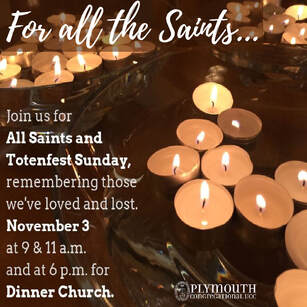
Isaiah 25: 6-10a All Saints Sunday, November 3, 2019 Plymouth Congregational Church, UCC The Rev. Jane Anne Ferguson Isaiah 25:6-9 25:6 On this mountain the LORD of hosts will make for all peoples a feast of rich food, a feast of well-aged wines, of rich food filled with marrow, of well-aged wines strained clear. 25:7 And he will destroy on this mountain the shroud that is cast over all peoples, the sheet that is spread over all nations; he will swallow up death forever. 25:8 Then the Lord GOD will wipe away the tears from all faces, and the disgrace of his people he will take away from all the earth, for the LORD has spoken. 25:9 It will be said on that day, Lo, this is our God; we have waited for him, so that he might save us. This is the LORD for whom we have waited; let us be glad and rejoice in his salvation. 25:10a For the hand of the LORD will rest on this mountain. The poetic prophecy of Isaiah is set against the backdrop of the Hebrew peoples’ physical and spiritual devastation when a foreign empire conquers their country and destroys their city, Jerusalem. Families are pulled apart as captives are taken into slavery in exile. Their homes are torn down around them. There is death all around. It seemed as if God had abandoned them! Death had cast a shroud over the whole people. If images from recent news of refugee camps and the devastation of Middle Eastern cities are coming to your mind, then you are getting the situation of God’s people in this text. Death is an “active force of negativity that moves to counter and cancel and prevent well-being,” writes Old Testament scholar, Walter Brueggemann.[i] Death, in its many forms, leaves us feeling diminished and separated from God. Grief after death is not a one time visitor....it’s thread runs through our lives in many ways. As a chaplain friend of mine says, “There are so many little deaths in life – dying is just one of them.” We most certainly experience the shroud of death Isaiah speaks of when our loved ones die. Some deaths are just way before their time and come with tragic circumstances. And even when the death of a loved one has been peaceful and comes naturally at the end of a vital, productive life we can still feel the devastation of loneliness and abandonment. We grieve many other losses in life..... job loss – relationship loss – loss of meaning in the midst of despair and depression – loss of community in moving across the country – the loss of a beloved pet. We grieve when we hear the news of violence against other human beings – gun violence, domestic violence, the violence of prejudice and injustices of all kinds, the violence of war. We grieve when we hear of and experience ecological violence against God’s creation. And we often feel helpless in the midst of grief, disgraced that we cannot lift ourselves up from the mire, that we cannot change the circumstances that caused us or others to grieve. We feel alone. In all these experiences our hearts, our souls, long for companions in community and in the presence of God. We need those who will walk beside us, following our lead as we move through the sorrow, the anger, the numbness, the loneliness. We need companions without judgment, without time frames, or fix-it solutions to cheer us up. We need companions who patiently walk with us toward the hope of transformation. The best gift we can give someone in grief is simply being a companion. The poet, Patricia McKernon Runkle beautifully expresses this kind of companioning in her poem “When You Meet Someone Deep in Grief.” Slip off your needs and set them by the door. Enter barefoot this darkened chapel hollowed by loss hallowed by sorrow its gray stone walls and floor. You, congregation of one are here to listen not to sing. Kneel in the back pew. Make no sound, let the candles speak. [ii] In other words, just be. You do not have to fix. Listen. Or simply sit in silence with the one in grief. Your presence is the balm, the greatest “fix” you can offer. The prophet Isaiah proclaims that our companioning God invites us to sit and be at God’s table of hope and abundance in the midst of grief and loss – in the midst of the many little dyings, as well as the big ones, in the midst of fear and devastation. At God’s table we are transformed by God’s companioning. God feeds us with love in a feast of rich food, a feast of well-aged wines – or here in Fort Collins, maybe we should say, well-brewed beer. The prophet declares that God will destroy the shroud, the sheet of deep grief that is spread over all nations; God will swallow up death forever and will wipe away the tears from all faces. I believe that in the death and resurrection of Jesus who is now the Christ, the redeeming presence of God with us, death was swallowed up forever in an ultimate and cosmic way that is both mystery and revelation. And we can trust this mystery because of the new life that it reveals. Friends, here in this community of God’s saints we endeavor to companion one another on the journey of life’s mystery that extends through and beyond physical death. God is our ever-present companion drawing us all together. As companioning community we are tangible evidence of the presence of God in all our lives. You have been and continue to be companions of your pastors as we continue to walk through the grief of my son’s death and through the grief of Hal’s cancer diagnosis and treatment. You are with us in tangible and intangible ways, in prayers, in the mountains of cards you have sent. You are with us in the prayer flags that you made for me after Colin’s death. They hung on our back fence for at least nine months until I noticed early this summer that they were disappearing. I finally realized those darn squirrels were taking them. Irritated I went out to salvage what was left, muttering to myself, “Those were MY prayer flags!” Then later that day Hal took me to our deck and pointed up. There in a very large, very tall, evergreen in our neighbor’s yard, way at the top of the tree, was a very colorful squirrel’s nest, made with prayer flags. They had been “transformed!” So they still companion me....and I hear Colin’s laughter each time I look at them. They assure me of God’s companioning presence that comes through you and through the beauty and surprise of nature. The words of Isaiah assure us that God’s hope is as abundant as a great feast. And that the shroud of death is not the ultimate future. God’s life is the ultimate future. God’s presence offers transformation because God is the ultimate companion in the many deaths of our lives. God comes into the darkened chapel of our souls and sits with us as a congregation of one, listening to our grief. God sends us to one another to listen as companions in grief. And through our companioning we are transformed in our individual grief as well as in our community. Transformed to companion those here in Fort Collins, in northern Colorado, in our country and around the world who suffer the death-dealing forces violence, prejudice and injustice. Even in the very real ache of grief we can say with the prophet and with conviction, God will swallow up death forever. God will wipe away all tears and take away the shroud of disgrace that covers the earth through human violence and greed. Don’t you want to participate with this companioning God in this miraculous transformation? The invitation is open as we companion one another through God’s love. © The Rev. Jane Anne Ferguson, 2019. All rights reserved. Permission is granted to reprint Patricia McKernon Runkle's poem from her website: griefscompass.com. [i] Walter Bruggemann, Isaiah 1 -39, (Westminster John Knox Press, Louisville, KY: 1998, 199). [ii] Patricia McKernon Runkle, “When You Meet Someone Deep in Grief”. The is poem is reprinted here with the permission of the poet. You can discover more about Patricia McKernon Runkle at her website, www.griefscompass.com and on Good Reads. Her book on her own grief journey after her brother’s death is titled, Grief’s Compass; Walking the Wilderness with Emily Dickinson. AuthorAssociate Minister Jane Anne Ferguson is a writer, storyteller, and contributor to Feasting on the Word, a popular biblical commentary. Learn more about Jane Anne here. 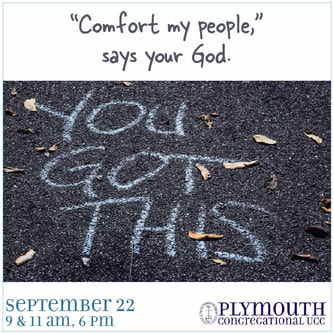
Isaiah 40.1-5
The Rev. Hal Chorpenning, Plymouth Congregational UCC Fort Collins, Colorado You and I are not the first people to live in difficult political times. We are not the first people to feel as though our world might be at an end. We are not the first people who need the cycle of lament, comfort, and hope. We are not the first people to turn to God in a vexing, unstable time. About 540 BC, when this middle section of Isaiah was written, some of the best and brightest in Jerusalem had been taken into captivity in Babylon, an abduction that lasted for nearly 60 years. Can you imagine what kind of fear and hopelessness you would feel if your favorite political and religious leaders were banished from your nation for two generations – so for us that is going back to the Kennedy Administration. What if all of the best and brightest minds in America had been taken away, and their children and grandchildren were only now returning? You and I are not the first people to live in difficult political times. And the treasure of Isaiah is that we get to hear the fresh words of God’s comfort…words that may be 2,500 years old, but that speak to us in a nation where leaders no longer value truth, where gun violence is accepted as inevitable, where income disparity grows wider, where immigrant children are separated from their parents and detained, where many deny their own racism, and where morality and justice are absent from the national dialogue. This dismal situation is not God’s final word. There is a reason that Martin Luther King, Jr., used this passage in his 1963 “I Have a Dream” speech. Dr. King knew that the evils of segregation and racism were not God’s final word. Singing is a way that God’s people have worked through tragedy across the millennia. The songs of the Civil Rights struggle are familiar to many of us, and the words of the prophet and captured in this one, short refrain: “Comfort, comfort, O my people! Tell of peace, thus says our God!” Will you sing it with me? “Comfort, comfort, O my people! Tell of peace, thus says our God!” These words of comfort are driven into our souls when we sing them. They become part of us, part of who we are and what we believe in the marrow of our being. That short refrain can be part of your spiritual toolkit that you bring with you everywhere. So, when you are watching the evening news and you hear about another school shooting, go ahead and sing: “Comfort, comfort, O my people! Tell of peace, thus says our God!” And when you are listening to NPR in your car and you hear of another strings of untruths that have been released over Twitter, “Comfort, comfort, O my people! Tell of peace, thus says our God!” And when you hear of the devastation of a hurricane, “Comfort, comfort, O my people! Tell of peace, thus says our God!” Now, that refrain is yours to bring with you wherever you go. Not that it is going to fix everything – it won’t – but it may provide enough of God’s energy – spiritual juice – for you to keep you going when things seem grim. It is a hard time that we live in, my friends. And if you and I don’t keep our spiritual batteries charged, we are not going to be able to engage the challenge and rise up to be co-creators of the realm of God here and now. It takes spiritual energy to go to the border with Mexico and bear witness. It takes spiritual energy to meet with Cory Gardner’s staff and witness that sane gun controls are essential for our nation. It takes spiritual energy to work toward the end of homelessness in our community. If we don’t lean into our faith, we will lose hope and wither. The good news is that we have a very deep well to draw from: the words of the prophets, the teachings of Jesus, and the presence of God in this very hour. Hope is a muscle that needs a workout to grow and develop. And like our forebears in the faith, we are being given an opportunity to do some spiritual weightlifting, to build hope, and to flex the muscles of our faith. I know that we are an accomplished, self-reliant bunch of folks, but as I told you a few weeks back, you are not alone, and you don’t have to do this on your own. We need hope and we need to rely on our God. And things will change if we work together. “Every valley shall be lifted up, and every mountain and hill made low.” It takes courage to have hope in the face of evil. People of faith have been doing it for millennia, and now the hour has come for us to know that God has our backs…that we must have hope and rely on the God who is with us, and on Jesus who proclaimed God’s realm of justice and peace that we pray for every Sunday. “Comfort, comfort, O my people! Tell of peace, thus says our God!” Amen. © 2019 Hal Chorpenning, all rights reserved. Please contact hal@plymouthucc.org for permission to reprint, which will typically be granted for non-profit uses. AuthorThe Rev. Hal Chorpenning has been Plymouth's senior minister since 2002. Before that, he was associate conference minister with the Connecticut Conference of the UCC. A grant from the Lilly Endowment enabled him to study Celtic Christianity in the UK and Ireland. Prior to ordained ministry, Hal had a business in corporate communications. Read more about Hal.
Isaiah 43.1-7
The Rev. Hal Chorpenning, Plymouth Congregational UCC Fort Collins, Colorado 
I know that for some of us, this is the most difficult Sunday of the year, because it provides an occasion when our grief can come to the surface again. Some of us have lost spouses, moms, dads, grandparents, children, dear friends. And though it is a difficult day, it is one of those rites of the church that acknowledge what we might rather sweep under the rug and ignore: that we are grieving, that we ache, that there is a piece of us that has died, too. And I stand with you this morning: I grieve, I ache, and a piece of me has died. And one of the reasons I love this place, this congregation, the church in all its failings and its glories is that we know how to come together and get real. We mark births with baptism. We mark marriages of opposite-sex and same-sex couples. We even have a rite in our UCC Book of Worship for the ending of a marriage! We know how to name things…to say “died” instead of “passed away” …to say “wife” or “partner” instead of “special friend”…we say “money,” instead of “benevolences.” I love this church because we know how to distinguished unvarnished truth from polite BS…because we aren’t afraid to be REAL and genuine with what we are experiencing and how it meshes and sometimes tangles with our faith. I love this church because we are a people who tie together personal faith and social responsibility. Yes, we are here this morning as people who are grieving or as those who are here to support them, and we are also here acknowledging that there is a sickness in our American culture that resulted in the violent deaths of eleven faithful Jews worshipping God at the Tree of Life synagogue in Pittsburgh. And we lift their lives up to God with love and light. Sometimes churches go astray when they become esoteric, with ritual and liturgy that say nothing to people or perhaps even to God. Sometimes churches reinforce the cultural norms of Empire and afflict the oppressed instead of providing them comfort. Sometimes churches are afraid to talk about controversial topics like sex, race, politics, and money. I am grateful that we try to avoid those pitfalls and that you are here today to be real…together. I love this church because we are not letting go of a central theme of our faith, which is to confront fear and to know that God is with us. God knows that we are going to be challenged, and God reminds us again and again: “Do not fear, for I am with you.” I love this congregation because when you come here you cannot help but know that you are not alone. In virtually every memorial service I lead, I include the New Creed from the United Church of Canada, whose refrain repeats like a heartbeat: “We are not alone…we are not alone.” And I say to you this day, welcome to this place, because we are not alone. Do not be fearful, because God is with us, and we stand together. I read and hear so much about loneliness and the absence of community in postmodern society, even as we are supposedly more connected by technology. WebMD claims that “Loneliness is a growing health epidemic.”[1] In fact, they say that loneliness rivals obesity and smoking as a health risk. The New York Times reports that loneliness affects longevity and causes imbalances in stress hormones like cortisol.[2] Part of the genius of church is that we still provide face-to-face relationships; we provide one of the only places where intergenerational community is the norm. Literally, for God’s sake, ministers still make house calls! This is not to say that we can all come to church more regularly and start smoking and eating more saturated fats…but most of us have known all along that we feel better when we connect with God and neighbors at Plymouth. And, yes, it is still possible to feel lonely here. So, if you are looking for a place to plug in at Plymouth, come and talk to one of your ministers…we’d love to help find a place where you feel at home here! Another truth for this Totenfest is that we all want to leave a legacy, to leave the world in better shape for having been here. And God knows the world needs our help. Earlier this week, I received a large envelope from a law firm here in town, and as I went through the pages I learned that one of our members who died last year, Lynn Richards, had included in her will a bequest for Plymouth. And I’m telling you this with her wife, Stacy’s, permission. The gift of $48,000 will become part of Plymouth’s endowment; it is the largest bequest our church has ever received. And I am deeply grateful that Lynn’s legacy includes a way to affect the mission of this congregation in perpetuity. Her caring will continue beyond any of our lifetimes…it’s a warm and wonderful reminder of Lynn, and it was particularly poignant to receive that letter during this week when we observe All Saints Day and Totenfest. I asked myself the question, “What legacy will I leave behind?” and I think it’s a good question for us all to ask. How do you want to be remembered by friends and family and community? What can you do today to affect the impact you will have on the world? How can you leave this planet a better place for having lived here? Life really is short. We really don’t have much time to gladden the hearts of those who are on this journey with us. So, we must be swift to love and to make a difference. And we must celebrate those whose lives we remember this day. Mary Oliver writes: “To live in this world You must be able to do three things: To love what is mortal; To hold it Against your bones knowing Your own life depends on it; And, when the time comes to let it go, To let it go.”[3] And for me, what makes the letting go possible is knowing that we are not alone, that God loves us, and has called us by name. I invite you to come forward if you wish, along the window aisle, and to speak aloud the name of someone you have loved and lost this past year. © 2018 Hal Chorpenning, all rights reserved. Please contact hal@plymouthucc.org for permission to reprint, which will typically be granted for non-profit uses. [1] WebMD, May 8, 2018. https://www.webmd.com/balance/news/20180504/loneliness-rivals-obesity-smoking-as-health-risk [2] “The Surprising Effects of Loneliness on Health,” NYT, December 11, 2017 [3] From “A Blackwater Woods” by Mary Oliver AuthorThe Rev. Hal Chorpenning has been Plymouth's senior minister since 2002. Before that, he was associate conference minister with the Connecticut Conference of the UCC. A grant from the Lilly Endowment enabled him to study Celtic Christianity in the UK and Ireland. Prior to ordained ministry, Hal had a business in corporate communications. Read more about Hal.
Ecclesiastes 3.1–11 & Isaiah 60.1–6
The Rev. Hal Chorpenning, Plymouth Congregational UCC Fort Collins, Colorado I’m not usually one to make New Year’s resolutions, in part because I am no good at keeping them. But we find ourselves together as a church on this last day of 2017, and it seems important to reflect on the past year and also to look ahead. And today is also the seventh day of Christmas, and though you’ll have to go outside to see “seven swans a-swimming,” we in the church still get to ponder the meanings and the potentials of Christmas, even if the presents under the tree have all been opened. If there is -– as the writer of Ecclesiastes claims -– a time for all things, then what time is it now? For many of us it seems as if the bitterness of our political discourse over the last year has dominated our thinking and our action. It has imbued some of our daily lives with a sense of fear and anxiety. The threat of a nuclear war with North Korea, threats to deport Dreamers, creating physical or legal walls to keep immigrants out, American withdrawal from the Paris Climate Accord, the take-back of financial support for the United Nations, the roll-back of protected national monument lands in Utah, the revelation of sexual abuse and harassment by many women, the moral bankruptcy of the religious right, the new tax law that enshrines corporate tax cuts in the hopes that some of the wealth will trickle down, the emasculation of the Environmental Protection Agency, the diminution of the role of science in federal agencies, and the “seven dirty words” that employees of the Centers for Disease Control are forbidden to use in agency budget documents. I’m not forbidden to use them: “science-based,” “fetus,” “transgender,” “vulnerable,” “entitlement,” “diversity,” and “evidence-based.” Feeling anxious yet? We’re actually seeing some of that anxiety here at Plymouth. I’m hearing it from some of you in conversation, and together we are experiencing it in the nervousness within our congregational family system…it is infecting our common life…how could it not? Many of us have never lived through a major war…some of you remember World War II and Korea and Vietnam, but for those of us who don’t remember those wars, Afghanistan and Iraq and the Gulf War seem very far away, perhaps because they were not fought by middle-class draftees. But in some ways, this time of national anxiety seems like a time of war…except that not all of us are on the same side. It seems like the fabric of our nation is fraying, and many of us have only lived through “a time to sew” and now we seem to be encountering “a time to tear” and to rend. Perhaps it feels like we are part of Isaiah’s prophecy: “Darkness shall cover the earth, and thick darkness the peoples.” It is a time like this that the world most needs people like you. It is a time to summon courage…the courage that you may not yet have had the opportunity to test. It is a time that the world most needs the ethical and moral witness of progressive Christianity. It is a time that the world most needs congregations like Plymouth that will stand up, using the life and teachings of Jesus to help steer our nation back toward compassion, justice, peace, freedom, integrity, honesty, selflessness, and generosity. What are the lessons we might derive during this time when the fabric frays? I think one of the lessons for middle-class folks is that it’s not all about us, that we have to become more active in community life and political life if we want to affect change. I think that for many of us, especially we who are comfortable, it will mean sacrifice for the common good. I think, to paraphrase John F. Kennedy, that it’s time not to ask what Plymouth can do for you, but to ask what you can do for Plymouth… because Plymouth continues to be one of the most critical voices and forces for progressive Christianity and progressive community in the region. You have been entrusted with the light and love of Christ. I don’t care if you have three advanced degrees or if you never saw the inside of a college classroom, whether you have a three-figure income or whether you are barely making ends meet, whether you feel too old or too young to pitch in, whether your ancestors came from Germany or Georgia or Korea or Kansas. You have been entrusted with the love and light of Christ, not simply so that you can feel warm and comfortable, but so that you can share that love and light with others. It’s time for us to stop worrying about the beauty of our remodeled kitchens and second homes and the newest brewery and instead to start thinking more about the needs of others, the needs of our community, the needs of God’s world. None of us has the luxury just to bask in the glow of our own wellbeing…because that glow is actually not ours, it is God’s. And that glow isn’t just to help us feel warmth and light…it is to provide warmth and light for God’s world. You know on Christmas Eve, those of us in the chancel have the best seat in the house, because we get to experience the wave of candlelight that spreads up and down the pews to create a sea of light. One flame makes only small a difference in a dark sanctuary, but the warm glow of hundreds of candles illuminate it in an almost magical way. So it is with the light that each of us has been given to bear. To be sure, we can illumine a few shadowy places on our own, but together, we can become a beacon of hope. It is easy for us to give ourselves over to despair, fear, hopelessness, and anxiety. But that is not the path you are called to follow as a bearer of Christ’s light. So, let’s get courageous as we finish one year and begin a new one. Let’s not shrink back from the call of our God to make a difference in the world. Let’s not recede into fear, but rather let us empower one another with faith and with light. We can live our lives from a place of fear and scarcity or we can live our lives from a place of faith and abundance…we just can’t do both with the same time. I leave you today with the “Amazing Peace: A Christmas Poem” by Maya Angelou (NY: Random House, 2005). Thunder rumbles in the mountain passes And lightning rattles the eaves of our houses. Flood waters await us in our avenues. Snow falls upon snow, falls upon snow to avalanche Over unprotected villages. The sky slips low and grey and threatening. We question ourselves. What have we done to so affront nature? We worry, God. Are you there? Are you there really? Does the covenant you made with us still hold? Into this climate of fear and apprehension, Christmas enters, Streaming lights of joy, ringing bells of hope And singing carols of forgiveness high up in the bright air. The world is encouraged to come away from rancor, Come the way of friendship. It is the Glad Season. Thunder ebbs to silence and lightning sleeps quietly in the corner. Flood waters recede into memory. Snow becomes a yielding cushion to aid us As we make our way to higher ground. Hope is born again in the faces of children It rides on the shoulders of our aged as they walk into their sunsets. Hope spreads around the earth. Brightening all things, Even hate which crouches breeding in dark corridors. In our joy, we think we hear a whisper. At first it is too soft. Then only half heard. We listen carefully as it gathers strength. We hear a sweetness. The word is Peace. It is loud now. It is louder. Louder than the explosion of bombs. We tremble at the sound. We are thrilled by its presence. It is what we have hungered for. Not just the absence of war. But, true Peace. A harmony of spirit, a comfort of courtesies. Security for our beloveds and their beloveds. We clap hands and welcome the Peace of Christmas. We beckon this good season to wait a while with us. We, Baptist and Buddhist, Methodist and Muslim, say come. Peace. Come and fill us and our world with your majesty. We, the Jew and the Jainist, the Catholic and the Confucian, Implore you, to stay a while with us. So we may learn by your shimmering light How to look beyond complexion and see community. It is Christmas time, a halting of hate time. On this platform of peace, we can create a language To translate ourselves to ourselves and to each other. At this Holy Instant, we celebrate the Birth of Jesus Christ Into the great religions of the world. We jubilate the precious advent of trust. We shout with glorious tongues at the coming of hope. All the earth’s tribes loosen their voices To celebrate the promise of Peace. We, Angels and Mortals, Believers and Non-Believers, Look heavenward and speak the word aloud. Peace. We look at our world and speak the word aloud. Peace. We look at each other, then into ourselves And we say without shyness or apology or hesitation. Peace, My Brother. Peace, My Sister. Peace, My Soul. Amen. © 2017 Hal Chorpenning, all rights reserved. Please contact hal@plymouthucc.org for permission to reprint, which will typically be granted for non-profit uses. AuthorThe Rev. Hal Chorpenning has been Plymouth's senior minister since 2002. Before that, he was associate conference minister with the Connecticut Conference of the UCC. A grant from the Lilly Endowment enabled him to study Celtic Christianity in the UK and Ireland. Prior to ordained ministry, Hal had a business in corporate communications. Read more about Hal.
Isaiah 40.1–11
The Rev. Hal Chorpenning, Plymouth Congregational UCC Fort Collins, Colorado December 3, 2017 I’d like to start with a question: What is the primary medium through which you get the news? Perhaps if I asked this question even five years ago, I would get a different answer. How many of you read a newspaper either in paper form or online? How many of you consider a news magazine like Time or The Week as the primary way you get the news? How many of you listen to radio as your primary news source? How about television news? How about from on online-only source like Buzzfeed or a news aggregator like Flipboard? How many of you rely on social media like Facebook for your news? I’d like to ask another question: How many of you find the news more upsetting, disquieting, overwhelming, anxiety-inducing, and downright scary than you did, say, two years ago? One of the things I notice in myself as I have shifted from sitting down at breakfast with the morning paper…a physical paper…and reading it online is the pace and flow of my consumption of the news. When you read a newspaper or a news magazine you are entirely in control of the pace of your reading. If you start to feel overwhelmed by the grief or anger of yet another woman who has been subjected to sexual harassment, you can pause, ponder, think about its context, and come back to the story. But if you are getting your news online and have sat down at the computer to read a story in the New York Times, you are less likely to take a pause to think, to consider, and to finish your cup of coffee. Electronic media -– even good journalism, which seems to be in decline -– stream at you and demand your attention in the way that paper sources do not. And that likely results in a sense of being overwhelmed by sensationalism, by inflammatory tweets, and by “entertainment” news that doesn’t really matter. And no matter how we get the news, the content itself seems more daunting every day. In her address accepting a lifetime achievement award from the National Book Award, author Annie Proulx last month offered a stinging and truthful summation of what we together confront: “We don’t live in the best of all possible worlds. This is a Kafkaesque time. The television sparkles with images of despicable political louts and sexual harassment reports. We cannot look away from the pictures of furious elements, hurricanes and fires, from the repetitive crowd murders by gunmen burning with rage. We are made more anxious by flickering threats of nuclear war. We observe social media’s manipulation of a credulous population, a population dividing into bitter tribal cultures. We are living through a massive shift from representative democracy to something called viral direct democracy, now cascading over us in a garbage-laden tsunami of raw data. Everything is situational, seesawing between gut-response ‘likes’ or vicious confrontations. For some this is a heady time of brilliant technological innovation that is bringing us into an exciting new world. For others it is the opening of a savagely difficult book without a happy ending. “To me the most distressing circumstance of the new order is the accelerating destruction of the natural world and the dreadful belief that only the human species has the inalienable right to life and God-given permission to take anything it wants from nature, whether mountaintops, wetlands or oil.”1 You may be wondering what this has to do with Advent. Listen to how one Old Testament scholar describes the setting for today’s scripture: “Events moved at a dizzying speed for the Jewish people between 550 and 515 BCE, the period of thirty-five years that produced” this section of the book of Isaiah. You will remember that this is the period when a significant number of the best and brightest of the Jewish people were taken into captivity and exile in Babylon. “The crises of those years would have tested even the most robust and secure of communities. But the Jewish community of”2 that time was neither robust nor secure. Even though they may have had been economically prosperous during that portion of the exile, their spiritual alienation was profound. “O Come, O Come, Emmanuel, and ransom captive Israel!” It doesn’t sound so very far off from where you and I find ourselves as we begin this trek through Advent this year. Some of us are enjoying a record-setting stock market; some of us will benefit from the tax plan the Senate passed yesterday, whether or not we oppose or support it; Colorado has a historically low 2.7% unemployment rate. But we all understand in our gut that something is not right. We are a people in exile. “O come, O come, Emmanuel!” Many in our nation may be enjoying material prosperity, but it comes as we face an environmental crisis of unparalleled proportions and it comes on the backs of those laboring in sweatshops in China and the developing world and in fields from California to Florida. We have a profound spiritual problem in this nation if we think the situation is acceptable. So, where do we turn? Where do we find comfort and joy in the face of a tsunami of bad news and injustice? Listen to the prophet: “The grass withers, the flower fades; but the word of our God will stand forever. Get you up to a high mountain… lift up your voice with strength, O Jerusalem, herald of good tidings, lift it up, do not fear; say to the cities of Judah, ‘Here is your God!’ “See, the Lord GOD comes with might…He will feed his flock like a shepherd; he will gather the lambs in his arms, and carry them in his bosom, and gently lead the mother sheep.” I was struck by what I heard in two separate conversations last week with members of our congregation. One woman, who is quite politically active, told me that Plymouth is the one place in her life that is a source of strength right now. One man who is experiencing a rough time with his family said that he comes to worship because it is the one hour a week when he can calm himself and just be at peace. “O Come, O come, Emmanuel!” And when I see our teens sleeping out on Plymouth’s front lawn for the 13th consecutive year to raise funds and awareness, I am warmed and given hope. Their efforts have an immediate impact, and the sleep-out also helps to inform who these young people are becoming and where their priorities lie. Whether they know it or not, our teens are bringing us and others comfort and joy! When we are planning worship at Plymouth, we don’t use a whole lot of electronic media, especially in the morning, in part because we want it to be a time when spiritual renewal can take place. So welcome to live, handcrafted, artisanal, free-range, no hormones added worship! I hope that it brings you joy! I know that part of the DNA of our congregation is doing and acting for justice, and I also hope that each of us can take comfort and deep joy from our faith and from the presence of God within and among us. “O Come, O come, Emmanuel!” In their dialogic Book of Joy, the Dalai Lama and Archbishop Desmond Tutu conclude that our pursuit for outward happiness based on things and accomplishments ultimately results in dissatisfaction and suffering. And that joy is something far more profound than happiness. The archbishop compares joy to a mother coming through the pain of childbirth and how that pain is transformed into the joy of bringing new life into the world. It is a metaphor with deep resonances in this Advent season as we prepare for the arrival of Christ once more. May you find a few deep breaths of peace even if you are overly busy. May you find comfort and joy in your faith, even if you are overwhelmed by the news. May you find a refuge and a sanctuary here at Plymouth to shelter you, to inspire you, and give you hope. O Come, O come, Emmanuel and ransom captive Israel, who mourns in lonely exile here; until the son of God appear. Rejoice! Rejoice! Emmanuel shall come to thee, O Israel! Amen. 1 reprinted at http://www.vulture.com/2017/11/annie-proulx-national-book-award- speech.html 2 Paul D. Hanson, Interpretation: Isaiah 40–66.(Phila.: WJK Press, 1995), p. 1 © 2017 Hal Chorpenning, all rights reserved. Please contact hal@plymouthucc.org for permission to reprint, which will happily be granted for non-profit uses. AuthorThe Rev. Hal Chorpenning has been Plymouth's senior minister since 2002. Before that, he was associate conference minister with the Connecticut Conference of the UCC. A grant from the Lilly Endowment enabled him to study Celtic Christianity in the UK and Ireland. Prior to ordained ministry, Hal had a business in corporate communications. Read more about Hal. |