Interested? Scroll down to contact form. Deadline 5/4/26.
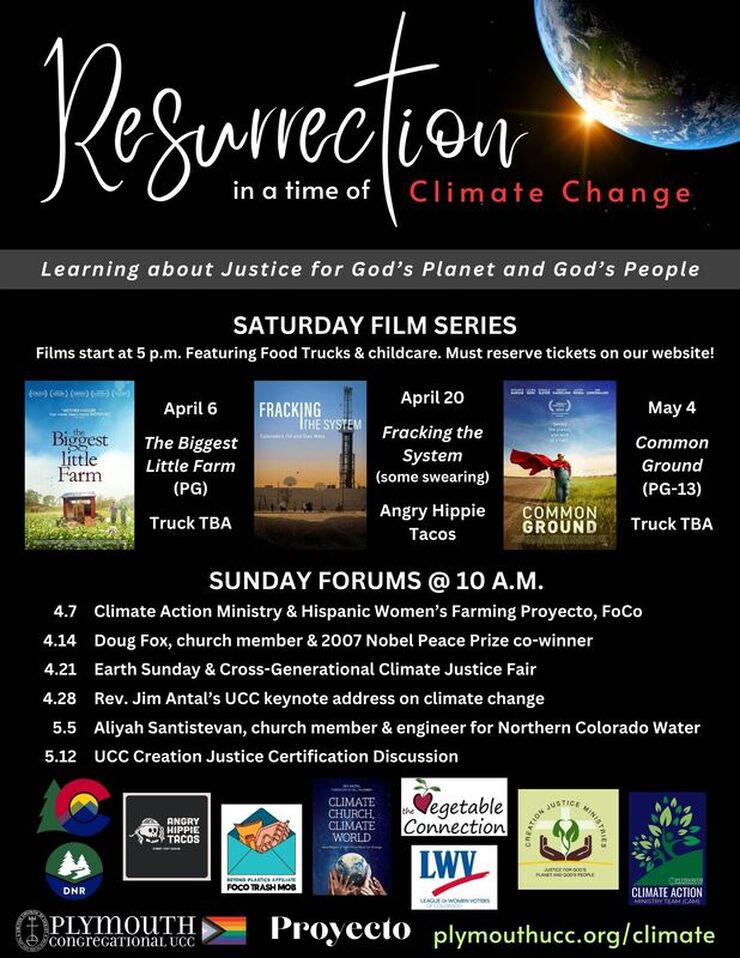
Concerned about climate change? Looking for ways to make a difference? Become part of Plymouth's Climate Action Ministry Team to act, advocate and learn together how we as households and as a congregation can make a difference. Involvement can take many forms and include all ages. For more information, or to sign up with us, please fill out the form below.
In 2025, with funds received from an Imagine grant from Outreach and Mission, CAM focused on establishing a community garden on church premises.
The project launched on March 9 with an all-church potluck and presentation by Michele Betsill. CAM organized four workdays in May and June for site preparation, raised-bed construction, planting, and landscaping.
Volunteers maintained the garden throughout the summer, including irrigation and watering. In August, volunteers built two compost bins and supported composting efforts.
In late fall, produce was distributed to FoCo Café, UCHealth’s food pantry, immigrant families, and Plymouth members. At least 25–30 volunteers contributed.
CAM ended the season with a potluck celebration and presentation in October.
Pollinators Are in Trouble Worldwide!
Did you know that bees and honey are mentioned 66 times in the Bible? Honey is a symbol for abundance and God's blessings. According to the USDA, three-fourths of the world’s flowering plants and 35% of the world’s food crops depend on animal pollinators to reproduce. Scientists estimate that 1 out of every 3 bites of food exists because of animal pollinators like bees, butterflies & moths, birds & bats, and beetles & other insects. Pollinators are keystone species, meaning they are critical to ecosystems.
However, pollinators are in trouble worldwide. They have suffered from pesticide use/loss of habitat with competition from non-native plant and animal species. Esther Bonney states in her TEDx talk - Have We Become Strangers to Our Own Nature? - "The pristine, weed free lawn, now a symbol of American status, offers little to support pollinators...Non-native, invasive species corrupt, destroy, and destabilize ecosystems by replacing native plants with invasive ornamentals and turf grass." According to the EPA, the average homeowner uses 10x more pesticides and chemical fertilizers/acre on their lawn than farmers use on their crops.
As followers of Christ, we are tasked with caring for all of creation. Approximately 103 million acres in the US are residential areas. If we work with nature even a small yard can make a big impact. Biodiversity is key! For example, specific species of native plants are needed to feed the insects that then feed the birds. 96% of birds are insect reliant for their food source. Of course, native plants also reduce the need for irrigation & fertilizers/pesticides as these plants are adapted to our local climate and soil conditions.
Xeriscaping shouldn't be just about reducing lawns. We can intentionally return parts of our yards to mimic nature and provide for our pollinator friends.
Judy Miotke
Want to learn more or get involved? Use the "Contact the CAM Team" form at the bottom of this page.
Our Ministry has just begun.
We have a small leadership team to help us move forward as a congregation to include climate and creation justice more thoroughly in what we do and how we do it. We will also be sending email notifications through the CAM email list of things you can do: write a letter, sign a petition, join a march, learn more, etc. We hope you will join us - our future generations need us, today, to take the actions needed to protect them and their futures.